
 Building
Codexscope
A local-first macOS app and CLI for searching Codex session history, jumping to exact transcript moments, and tracing subagent families.
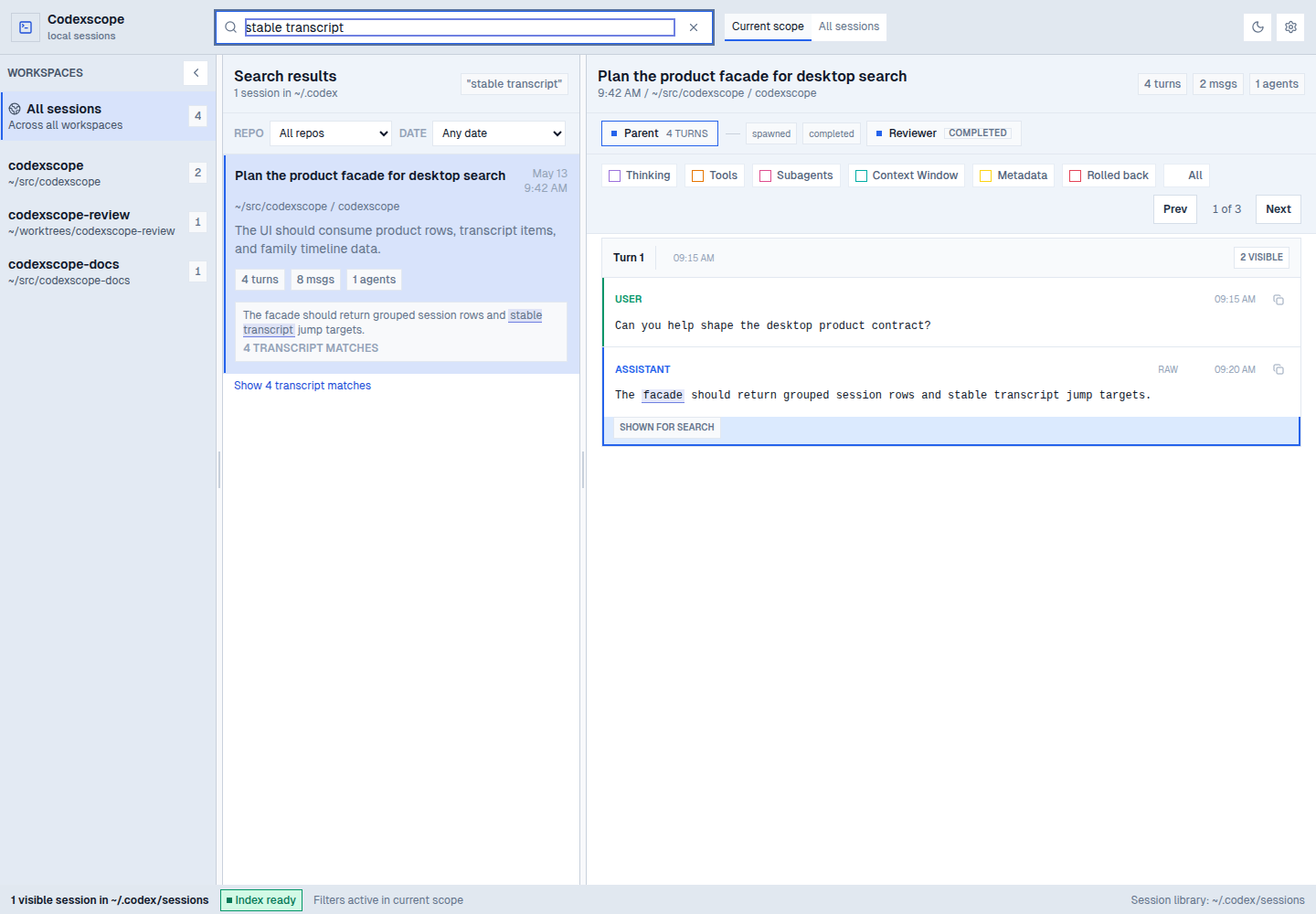
Search lands on the exact matching turn, while the complete local transcript remains visible beside it. This image uses bundled fixture data.
Finding the moment, not just the file
Codex sessions are useful long after they finish, but only if the relevant decision can be found again. Codexscope indexes local session history, searches across it, and opens the transcript at the exact matching turn. It also shows token use and compaction boundaries, which helps explain why a long-running session changed shape.
The app distinguishes the active transcript from raw history left behind by a rollback. That keeps search results honest without discarding evidence that may still matter.
One engine, two ways in
The macOS app and CLI share a Rust engine and SQLite full-text index. The GUI is for browsing, reading, and following relationships. The CLI keeps the same search and inspection model available in a terminal, without maintaining a second interpretation of the archive.
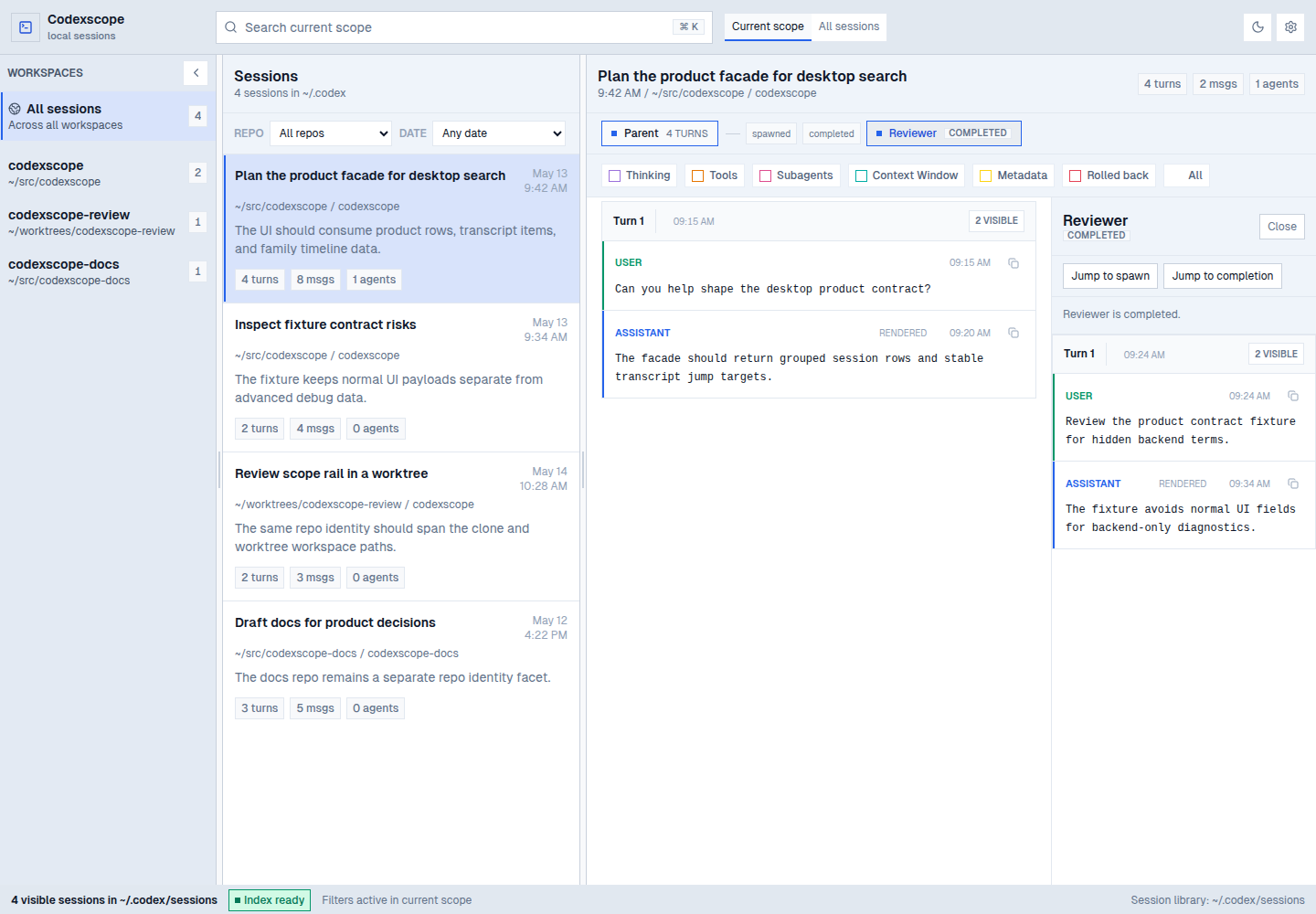
Parent and subagent sessions form a navigable family instead of appearing as unrelated files. This image uses bundled fixture data.
Subagent relationships are reconstructed into a family view. From a root session, I can see delegated branches and move through the transcripts that actually produced a result.
Built against the messy archive
I tested the app against 2,228 sessions from my own archive. That scale exposed problems a tidy demo did not: switching roots while work was in flight, partially written sessions, stale lifecycle state, and searches that felt fast on a fixture but not on years of history.
Codexscope is still building. I do not yet treat every lifecycle and performance edge as launch-hardened.